



















Friday, March 7: Bandersnatches
REVISING HISTORY
by Steven Steinbock
This past week I had the pleasure of re-reading Jack Finney’s 1955 novel The Body Snatchers (republished as Invasion of the Body Snatchers in 1978).
Back in the 1980s, when Simon & Schuster was reprinting Finney’s Time and Again as a trade paperback (under their Fireside Books imprint), they collected some of his earlier works, including a book of true crime, an anthology of 12 short stories, a collection of three novellas, and Invasion of the Body Snatchers.
What attracted me at first to Time and Again twenty years ago was that it was a time travel mystery novel. At that time I grabbed up all the Finney I could find, including all the aforementioned, as well as sea adventure Assault on a Queen (1959) and prison escape caper The House of Numbers (1956).
What has always stood out for me about Finney’s writing is the fun, the pure joy with which he writes. Even when writing about murder, prison escapes, or the alien takeover of earth, you can tell as you read that Finney was enjoying himself as he wrote. The Body Snatchers is frightening, to be sure. But in contrast to either of the film adaptations, there’s an odd, very human levity to the writing. In fact, if anything, it was the levity of Finney’s authorial voice – contrasted with the emotional flatness of the pod-people – that made The Body Snatchers work so well.
If you haven’t read Finney, the above may not make sense. Without ever being ha-ha funny, Finney’s style has a lightness in tone. Without ever sacrificing professionalism, Finney knew how to have fun with his words, and to capture a sort of conversational tone that often falls flat when coming from a less skilled writer. Two other authors who accomplish this are Fredric Brown, whom I’ve written about elsewhere, and Lawrence Block, who continues to provide me pleasure with each new book he writes.
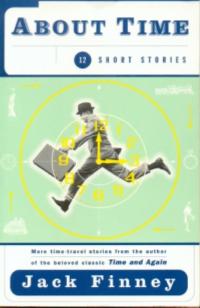 (Here and now I want to give my strongest recommendation to Finney’s writing. Since this is a short story forum, please have a look at About Time and 3 By Finney . I also found this interesting website. It appears to be a work in progress that stopped progressing a while back, but it does have dozens of complete short stories that you won’t find anywhere else).
Re-reading The Body Snatchers recalled for me my only complaint about the Simon & Schuster reprints. Before these reissues were published, Finney “revised and updated” much of his work. I think I first noticed this when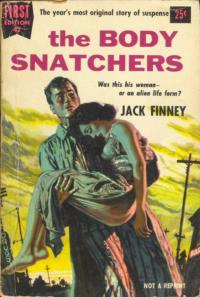 reading 3 by Finney, which collected three of Finney’s shorter novels. I can’t remember the details – it’s been twenty years – but there were some unsettling anachronisms. Perhaps one of the stories had a distinctly 1960s feel, but had Ronald Reagan or Michael Jackson roughly inserted into the narrative. Again, I don’t remember the exact details. There may not have been any mention of Reagan or Jackson, but there was something that didn’t fit. Something that – even for an author known for clever takes on time travel – came off as anachronistic.
And so, while re-reading The Body Snatchers, some of Finney’s updates kept jarring me. On the very first page the narrator tells us, “it all began around six o’clock, a Thursday evening, October 28, 1976. . .” I pulled out the 1955 Dell First edition and checked the first page. It read: “it all began around six o’clock, a Thursday evening, August 13, 1953. . .” (emphasis added to show changes).
A few chapters in, when several characters are discussing a “contagious neurosis” taking over Mill Valley, the narrator comments, “It’s a new hobby over our way. . .a cinch to replace jogging.” I checked page 23 of the original: “It’s a new hobby over our way. . .a cinch to replace weaving and ceramics.” On page 27 of the revised edition, the narrator tells Becky, “You look great,” while in the 1955 version she looks “swell.” In 1955 the narrator makes a wisecrack about joining “an abortion ring” while after Roe v. Wade, the text was changed to the less powerful “I was switching my practice entirely to abortions.” In one scene, the narrator takes his date to a movie, which (in the revised version) turns out to be an adaptation of Finney’s own Time and Again.
These charges are minor, but unsettling. I recall watching a “cleaned-up” version of Mel Brooks’ Blazing Saddles on network TV a few years ago. In the scene where the little old lady slugs Cleavon Little, her line was redubbed: “Up yours, Negro” – while the original was uncomfortably hilarious, the revision fell pathetically flat.
When Random House first published Robert Arthur’s “Three Investigators” mysteries, they were marketed as “Alfred Hitchcock and the Three Investigators,” with the famous movie director as the friend and mentor of the three young sleuths. But after Hitchcock’s death, the great director was excised from the American reprint editions of these books. Hitchcock was gone from the titles, and some generic Hollywood mogul was shoved into the text.
For years I wanted to watch the original theatric version of Ridley Scott’s “Blade Runner.” But for over twenty years, that version of the film was not legally available anywhere – banned like Disney’s “Song of the South” – until just a few months ago when the 5-disc “Ultimate Collector’s Edition” included that theatrical version along with Scott’s “Director’s Cut.”
So I ask: when is it appropriate to revise literature? If Huck Finn’s use of the “N” word makes us uncomfortable, should he refer to Jim as an African American? If Shylock’s and Fagin’s ethnicity offends, is it okay for us to whitewash Shakespeare and Dickens. If Nancy Drew’s friends find say “gosh” in 1928, is it okay to change it to “groovy” in 1968 and “bitchin’” in 2008? What’s next? Will Nancy and her friends begin speaking in emoticons and text-message abbreviations?
I know how I feel about revision. Once a book or story has been printed, the only changes that should be made are typo corrections. Political incorrectness and internal inconsistencies can be addressed in a foreword or in footnotes, but not by changing the original work. And I approve of this message (until such a time that I amend it).
Steven, that Jack Finney website is absolutely amazing. It’s like time travel back to the 1950s! Loved those magazine covers…
Great column, Steven. I love Jack Finney’s books, especially Time and Again and its sequel — what great descriptions of New York City. I also agree with you on revisions, and the fact that a simple foreword could solve that problem.
Thanks, by the way, for the link to the Finney website.
TIme and Again is a classic. How many books have made lists of best mysteries AND best science fiction?
I sympathize with the revision complaints. Get me started on The President’s Analyst some time.
http://www.devo.com/bladerunner/
You might enjoy the online magazine concerning the movie.
Terrific piece, both on Finney (I concur with everything you wrote) and on the insanity of selective updating. It almost never works. As I recall, one of the updated Finneys, written at a time when the only recourse for private movie collectors was eight-millimeter film, was hamhandedly updated to the time of the VCR and made no sense whatever.
Great column. Did Finnyey ever use “suctiion cups”
in his time travel descriptions?
A novel or short story is of the place and time it is written. To me the joy of reading books written in, say, the twenties or thirties is that they take me into that era.
Updating along with political correctness is another form of censorship. Updating could eventually mean that Madame Bovary and Anna Karenina would not committ suicide. Because what reader today would believe that a woman should kill herself over an affair gone wong. The updaters would send Emma and Anna to therapy and if that fails –divorce. The end.
I even hate stage productions by hip directors who put everybody in contemporary costume to make some idiotic point — Peter Sellars’ opera productions were particularly egregious — “Le nozze di Figaro” in Trump Tower, “Don Giovanni” as a South Bronx gang-banger, “Pelléas et Mélisande” in Malibu. Truly barf-worthy.
Revisionism is the ultimate act of egotism.
I enjoy traveling back to an era and reading language “how it was.” There’s nothing that yanks me out of the story faster than realizing the author (or perhaps it’s the publisher) who’s decided to be politically correct by today’s standards, but the setting is definitely of another time. Thanks for the great article and the loan of the Ellery Queen covers for my article yesterday.
I time-traveled, thanks to you, back to my College days circa 1982 when I stumbled across the Reader’s Digest version of “Time and Again” in the school library. My homework did not get done that night, the book transfixed me. I later read all the Finney I could find. And I agree about the revisions, I lucked out on finding a vintage copy (for a buck!) of “Body Snatchers.” Gotta go! I’m gonna check out that website! Walter Braden Finney ROCKS!!!!
Melodie: suction cups, suction cups. Hmm. He might have used them to describe a flying saucer. No! That was somebody else)!
James: I don’t think revisionism is necessarily egotism. But I do think it’s a mistake. And barf-worthy? I didn’t think I’d every read those words coming from your polished keyboard.
Rob: President’s Analyst? Pray tell.
Alisa: Thanks for the Blade Runner link.
Everyone else: Thanks.
Further thoughts: While I’m against post-publication revision, I’m not always against re-visioning things. Certainly, a lot of re-visioned art turns out – as JLW put it – barf-worthy.
But remember, much if not most of Shakespeare was a retelling – a re-visioning – of existing stories. And they didn’t turn out half bad. And (while I don’t want to compare it to Shakespeare) the re-visioned “Battlestar Galactica” – unlike nearly every other remake of an old TV show – is pretty darn good.
And some published writers don’t consider a work ever finished. The poet Ogden Nash sure didn’t! His poem that reads in its entirety “Candy is dandy/But liquor is quicker” was ammended in the 1970’s, adding an end line “Pot is not.”
You don’t read Shakespeare for the stories. You read him for the language. And changing THAT is what gets you into trouble.
Alexander Pope considered himself a better poet than Shakespeare and felt no compunction against “improving” the Bard’s verse in his edition of the plays. He was called on it by Lewis Theobald, who then produced his own edition of Shakespeare, generally considered to be the first scholarly edition ever published. The Wasp of Twickenham, of course, reacted badly to Theobald’s criticism, and subsequently cast Theobald as the hero of his mock epic “The Dunciad”. (Changed to Colley Cibber after Theobald’s death, by the way, which just goes to show that Pope never wasted ammunition.)
But Pope’s reputation materially suffered from his ostentation. He was wrong to try to force Shakespeare to conform to contemporary tastes. It was motivated by his own misplaced sense of superiority. That’s why I call it an act of egotism.
But as far as re-tellings are concerned — well, my first cover story for AHMM, “Miching Malicho”, stole its plot from “Macbeth”, lock, stock, and cauldron.