



















Friday, June 8: Bandersnatches
THE LUCKY THIRTEEN – Part Two
by Steven Steinbock
Last week I told you about three of my favorite mystery anthologies: Dorothy L. Sayers’ The Omnibus of Crime (1928), Detection Medley edited by John Rhode for the Detection Club (1939), and 101 Years’ Entertainment edited by Ellery Queen (1941). Special thanks to Tom Walsh for his comments on 101 Years’ Entertainment. Other than his, there were only two comments, one was my response to Tom, and the other was my wife. Thanks, hun.
I expected that my provocative comments about Dorothy Sayers would prompt at least some angry responses. Don’t be shy. Please put in your own two-cents’ worth. Have you read any of these anthologies? Do you have favorites of your own?
This week I’ll continue my annotated list of favorite crime story collections with three more choices. Please note that I’m no longer listing my selections in order of date of publication. I’m also getting nervous about being able to keep to my original thirteen.
Here are my next three selections:
Anthony Boucher’s Four-&-Twenty Bloodhounds (1950). Long out of print and fairly scarce, this volume contains twenty-four chapters devoted to twenty-four detectives (amateur, P.I.s, and cops). There are twenty-two short stories, plus an essay by Brett Halliday about his gumshoe “Michael Shayne,†and two short-shorts by Clayton Rawson about his magician sleuth, “The Great Merlini.†Great stories by Commings, Carr, Queen, Kane (Frank), and Coxe. One rarity in the volume is a story by Robert Arthur featuring “The Mysterious Traveler,†from his long-running radio series.
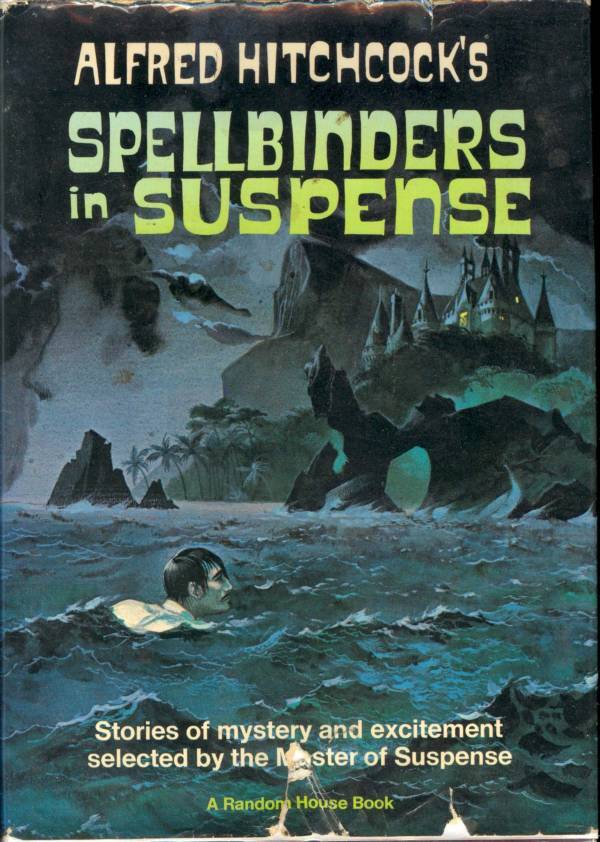
Alfred Hitchcock’s Spellbinders of Suspense, edited by Robert Arthur (uncredited, and mentioned in the previous paragraph) (1967). In the mid-1960s there were a bunch of anthologies published under the “Alfred Hitchcock†name. These books tended to be marketed toward juvenile and young adult readers, which may explain why, at the age of ten or eleven, I checked Alfred Hitchcock’s Monster Museum out of the school library so many times. Hitchcock was probably not involved in these books except to lend his name and pick up his check. The ghost-editor of most of these was Robert Arthur, who also wrote ten of the “Alfred Hitchcock and the Three Investigators†mysteries, and “The Mysterious Traveler†radio series (see above). Spellbinders of Suspense might be a good introduction for younger readers, but it’s no kid stuff. The thirteen stories within the hardcover edition (the paperback reprint only contained nine) include mysteries like Christie’s “The Chinese Puzzle Box,†Sayers’ “The Man Who Knew How,†and Patrick Quentin’s “Puzzle for Poppy,†as well as some classic thrillers like Daphne du Maurier’s “The Birds,†Richard Connell’s “The Most Dangerous Game,†and Robert Bloch’s unforgettable “Yours Truly, Jack the Ripper.â€
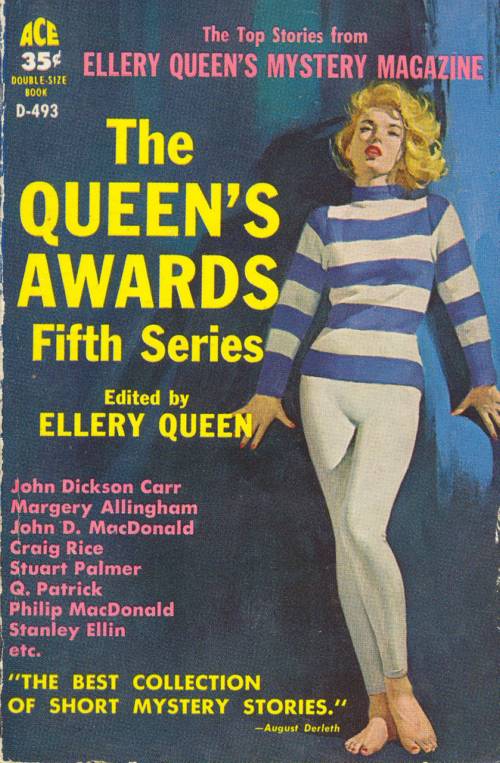
The Queen’s Awards (Fifth Series) (1950). Beginning in1946 and going through 1957, Dannay and EQMM sponsored an annual “Mystery Short Story Contest.†The winners, selected from the stories published in EQMM, were published in these annual volumes. (After 1957, the series evolved into the Ellery Queen Mystery Anthology series, which ran into the 1980s. I’ll have more to say about these volumes in coming weeks). All the Queen’s Awards collections were good, filled with mostly familiar names. I had a tough time picking just one. I settled on Fifth Series which contains stories by John Dickson Carr, Stanley Ellin, Margery Allingham, Philip MacDonald, John D. MacDonald, and T.S. Stribling, to name a few. The story “Once Upon A Train†is of a series of collaborative efforts done by Craig Rice and Stuart Palmer featuring their two series sleuths, lawyer John J. Malone and schoolteacher Mrs. Hildegarde Withers.
Next week, unless I get waylaid, I’ll take a stab at Hans Santesson’s The Locked Room Reader (1968), Hugh Greene’s The Rivals of Sherlock Holmes (1970), and possibly Haycraft and Beecroft’s A Treasury of Great Mysteries (1957). See you then.
Five of the six anthologies recommended so far by Steven Steinbok are available from Amazon-affiliated resellers. (No, I’m not a shill for Amazon or for anyone who sells through Amazon. I’m just making the point that these “old” books are still for sale. They can be yours if you don’t mind buying used books.) Here’s what I found around 8 AM (East Coast Time):
The Omnibus of Crime (1928) – 6 used; Detection Medley (1939) – none; 101 Years’ Entertainment (1941) – 19 used; Four & Twenty Bloodhounds (1950) – 9 used; Alfred Hitchcock’s Spellbinders of Suspense (1967) – 11 used, 1 new; The Queen’s Awards (1950) – 1 used.
Glad to see you mentioning Robert Arthur and the Hitchcock books. They had an effect on me. I will be mentioning him in an upcoming blog entry.
Okaaaaay. I could let it be said once, but not twice!
When I was a kid, I loved Dorothy Sayers. A couple of her contemporaries I did find bloated and pompous, even abstruse and smug about it. I’ll always suspect that a part of my brain was permanently damaged by slogging through the first four of Tolkien’s Lord of the Ring novels. It’s heresy, I know, but for that reason, I never attempted The Simirillion.
However, Dorothy never struck me that way, not exactly. Then again, I was inculcated with classics, so I never found Poe or Dickens harder to read than anything else.
Yet… and this fits in with the thread of CriminalBriefs and may tie in with ‘bloated’… I never thought her novels were her best fiction. On my personal list of anthologies would have been Dorothy’s collection of Lord Peter short stories.
To my mind, her shorts stood taller than her novels. They contained plot, characterization, and usually a decent mystery.
What Steven didn’t mention was that even Dorothy’s contemporary critics complained that Sayers had fallen in love with her character to the detriment of her writing.
So, perhaps in a way, we are saying the same thing: As famous as she is for her Lord Peter novels (among other works), they may not be considered her best examples.
But personally, her short stories are near the top of my list.
Stepping down from my imaginary soapbox, I love Lord Peter and Bunter. I don’t even mind Harriet Vane. I suppose my biases stem from a couple things.
Years ago, a friend of a friend who would never think of reading a detective novel told me to read GAUDY NIGHT because it was “simply genius.” I read it. I think I may have even liked it. But if Sayers ever wrote a bloated book, that was it.
The other reason for my attitude has more to do with Sayers than with her writing. In life (as opposed to “in print”) she was pompous and bigoted. She was mean to Margery Allingham and the other women in The Detection Club. She blackballed Julian Symons from the club for years, presumably because he was Jewish. (She was pretty nasty in her descriptions of Jews in her writing, and I’m pretty thick skinned about such things).
I would agree with Leigh that her short stories were generally stronger than her novels. But I remember being completely thrilled by STRONG POISON, HAVE HIS CARCASE, and THE NINE TAILORS.
Rob, I look forward to reading your entry on Robert Arthur. Are you referring to the “Three Investigators” books or the anthologies?
The “Three Investigators” series had a huge impact on me. I still want a secret headquarters like the one in Uncle Titus’ junkyard. Dennis Lynds wrote a bunch of those books after Robert Arthur passed away.
Gaudy Night is my wife’s favorite Sayers novel, although she is also partial to The Nine Tailors and Murder Must Advertise. Although all three of these novels contain mysteries, the things that make them most interesting are the milieus in which they take place–the women’s college in Oxford in GN, the background of campanology in TNT, and the Ad Game in MMA.
I think that one of the reasons why you might consider GN to be bloated is because Americans were much more liberal much earlier about women’s university education than our (all right, my) British cousins. As a study of the struggles women endured to be accepted academically, I found GN quite instructive and moving.
I never let an author’s character interfere with my enjoyment of her work. Sayers was a seriously flawed human being, to be sure. I’m sure she considered herself something of a moralist, and it is now well known that she kept her illegitimate child a closely held secret for fear of compromising her reputation as a devout Christian. But she is equal now with her entire generation, high or low.
I had not known about Sayers’ personal life, but I regret to say that I am notorious for my vast lack of curiosity (some say ignorance) of celebrities, rich and famous, at least within the last 100 years.
Steve, I was thinking of the Three Investigator books although I remember the anthologies too. Only recently I was telling someone about a brilliant story in one of them about a scientist doing research on alligators. (I think it was in Monster Museum.)
I’m not suprised you have such great taste in anthologies. One added inducement to the early QUEEN’S AWARDS volumes is the running commentary by Dannay on the contests and how the judging was done, along with other sidelights on the stories and their authors. It often expanded on the rich editorial notes that characterized EQMM in its first decade and occasionally thereafter. Unfortunately, the later awards volumes did away with the commentary entirely.
What I liked most about 101 YEAR’s was that its stories were presented in an understandable order. My top pick, however, would be for Ellery Queen’s well-styled 560 page ROGUES’ GALLERY from 1945. But that’s near cheating.
It’s funny, those AH ‘school library stocked’ anthologies turned a younger me away from mysteries (after reading a couple dozen of 3 Investigaters!). Yet it was the seasonally issued double-sized & no nonsense magazine editions, incl. those of EQMM, in the mid-late 80s which brought me back.
In recent years, I’ve read thru a couple of those older AH’s. They did tend to include a rather loose definition of mystery.