




















Tuesday, September 8: Surprise Witness & Mystery Masterclass
Here are Chapters IV and V of “The Queen of Spades”. Since there are more than the usual number of footnotes, in the interest of brevity I have forborne from making the usual general comments at the column’s end — in any case, I’m sure the Gentle Reader is perfectly capable of interpreting things for himself (or herself). In next week’s Scribbler, I will publish the conclusion of the story and again heave my rotund frame up on the old soapbox.
—JLW
THE QUEEN OF SPADES
by Alexander Pushkin
IV
Homme sans moeurs et sans religion.1
A Correspondence.
Lizaveta Ivanovna was sitting in her room, still in her ball dress, lost in deep thought. On returning home, she had hastily dismissed the chambermaid, who very reluctantly came forward to assist her, saying that she would undress herself, and with a trembling heart had gone up to her own room, expecting to find Hermann there, but yet hoping not to find him. At the first glance he was not there, and she thanked her fate for having prevented him keeping the appointment. She sat down without undressing, and began to call to mind all the circumstances which in a short time had carried her so far. It was not three weeks since the time when she had first seen the young officer from the window — and yet she was already in correspondence with him, and he had succeeded in inducing her to grant him a nocturnal interview. She knew his name only through his having written it at the bottom of some of his letters; she had never spoken to him, had never heard his voice, and had never heard him spoken of until that evening. But, strange to say, that very evening at the ball, Tomsky, being piqued with the young Princess Pauline ***, who, contrary to her usual custom, did not flirt with him, wished to revenge himself by assuming an air of indifference: he therefore engaged Lizaveta Ivanovna, and danced an endless mazurka with her. During the whole of the time he kept teasing her about her partiality for Engineer officers, he assured her that he knew far more than she imagined, and some of his jests were so happily aimed, that Lizaveta thought several times that her secret was known to him.
“From whom have you learned all this?” she asked, smiling.
“From a friend of a person very well known to you,” replied Tomsky, “from a very distinguished man.”
“And whom is this distinguished man?”
“His name is Hermann.” Lizaveta made no reply, but her hands and feet lost all sense of feeling.
“This Hermann,” continued Tomsky, “is a man of romantic personality. He has the profile of a Napoleon, and the soul of a Mephistopheles.2 I believe that he has at least three crimes upon his conscience. How pale you have become!”
“I have a headache. But what did this Hermann, or whatever his name is, tell you?”
“Hermann is very dissatisfied with his friend. He says that in his place he would act very differently. I even think that Hermann himself has designs upon you; at least, he listens very attentively to all that his friend has to say about you.”
“And where has he seen me?”
“In church, perhaps; or on the parade. God alone knows where. It may have been in your room, while you were asleep, for there is nothing that he — ”
Three ladies approaching him with the question: “oubli ou regret?”3 interrupted the conversation, which had become so tantalizingly interesting to Lizaveta.
The lady chosen by Tomsky was the Princess ***4 herself. She succeeded in effecting a reconciliation with him during the numerous turns of the dance, after which he conducted her to her chair. On returning to his place, Tomsky thought no more either of Hermann or Lizaveta. She longed to renew the interrupted conversation, but the mazurka came to an end, and shortly afterwards the old Countess took her departure.
Tomsky’s words were nothing more than the customary small talk of the dance, but they sank deep into the soul of the young dreamer. The portrait, sketched by Tomsky, coincided with the picture she had formed within her own mind, and, thanks to the latest romances, the ordinary countenance of her admirer became invested with attributes capable of alarming her and fascinating her imagination at the same time. She was now sitting with her bare arms crossed, and with her head, still adorned with flowers, sunk upon her uncovered bosom. Suddenly the door opened and Hermann entered. She shuddered.
“Where were you?” she asked in a terrified whisper.
“In the old Countess’s bedroom,” replied Hermann. “I have just left her. The Countess is dead.”
“My God! What do you say?”
“And I am afraid,” added Hermann, “that I am the cause of her death.”
Lizaveta looked at him, and Tomsky’s words found an echo in her soul: this man has at least three crimes upon his conscience! Hermann sat down by the window near her, and related all that had happened.
Lizaveta listened to him in terror. So all those passionate letters, those ardent desires, this bold, obstinate pursuit — all this was not love! Money — that was what his soul yearned for! She could not satisfy his desire and make him happy. The poor girl had been nothing but the blind tool of a robber, of the murderer of her aged benefactress! She wept bitter tears of agonized repentance. Hermann gazed at her in silence; his heart, too, was a prey to violent emotion, but neither the tears of the poor girl, nor the wonderful charm of her beauty, enhanced by her grief, could produce any impression upon his hardened soul. He felt no pricking of conscience at the thought of the dead old woman. One thing only grieved him: the irreparable loss of the secret from which he had expected to obtain great wealth.
“You are a monster!” said Lizaveta at last.
“I did not wish for her death,” replied Hermann, “my pistol was not loaded.” Both remained silent. The day began to dawn. Lizaveta extinguished her candle, a pale light illumined her room. She wiped her tear-stained eyes, and raised them towards Hermann. He was sitting near the window, with his arms crossed, and with a fierce frown upon his forehead. In this attitude he bore a striking resemblance to the portrait of Napoleon. This resemblance struck Lizaveta even.
“How shall I get you out of the house?” said she at last. “I thought of conducting you down the secret staircase.”
“I will go alone,” he answered.
Lizaveta arose, took from her drawer a key, handed it to Hermann, and gave him the necessary instructions. Hermann pressed her cold, inert hand, kissed her bowed head, and left the room.
He descended the winding staircase, and once more entered the Countess’s bedroom. The dead old lady sat as if petrified, her face expressed profound tranquillity. Hermann stopped before her, and gazed long and earnestly at her, as if he wished to convince himself of the terrible reality. At last he entered the cabinet, felt behind the tapestry for the door, and then began to descend the dark staircase, filled with strange emotions. “Down this very staircase,” thought he, “perhaps coming from the very same room, and at this very same hour sixty years ago, there may have glided, in an embroidered coat, with his hair dressed à l’oiseau royale5 and pressing to his heart his three-cornered hat, some young gallant who has long been moldering in the grave, but the heart of his aged mistress has only today ceased to beat.”
At the bottom of the staircase Hermann found a door, which he opened with a key, and then traversed a corridor which conducted him into the street.
V
That night the dead Baroness von W. appeared to me. She was
all in white and said: “How do you do, Mr. Councillor?”
—Swedenborg6
Three days after the fatal night, at nine o’clock in the morning, Hermann repaired to the Convent of ***, where the last honors were to be paid to the mortal remains of the old Countess. Although feeling no remorse, he could not altogether stifle the voice of conscience, which said to him: “You are the murderer of the old woman!” In spite of his entertaining very little religious belief, he was exceedingly superstitions; and believing that the dead Countess might exercise an evil influence on his life, he resolved to be present at her obsequies in order to implore her pardon.
The church was full. It was with difficulty that Hermann made his way through the crowd of people. The coffin was placed upon a rich catafalque beneath a velvet baldachin. The deceased Countess lay within it, with her hands crossed upon her breast, with a lace cap upon her head, and dressed in a white satin robe. Around the catafalque stood the members of her household; the servants in black caftans, with armorial ribbons upon their shoulders and candles in their hands; the relatives — children, grandchildren, and great-grandchildren — in deep mourning.
Nobody wept; tears would have been an affectation. The Countess was so old that her death could have surprised nobody, and her relatives had long looked upon her as being out of the world. A famous preacher delivered the funeral sermon. In simple and touching words he described the peaceful passing away of the righteous, who had passed long years in calm preparation for a Christian end. “The angel of death found her,” said the orator, “engaged in pious meditation and waiting for the midnight bridegroom.”
The service concluded amidst profound silence. The relatives went forward first to take a farewell of the corpse. Then followed the numerous guests, who had come to render the last homage to her who for so many years had been a participator in their frivolous amusements. After these followed the members of the Countess’s household. The last of these was an old woman of the same age as the deceased. Two young women led her forward by the hand. She had not strength enough to bow down to the ground — she merely shed a few tears, and kissed the cold hand of the mistress.
Herman now resolved to approach the coffin. He knelt down upon the cold stones, and remained in that position for some minutes; at last he arose as pale as the deceased Countess herself; he ascended the steps of the catafalque and bent over the corpse. . . . At that moment it seemed to him that the dead woman darted a mocking look at him and winked with one eye. Hermann started back, took a false step, and fell to the ground. Several persons hurried forward and raised him up. At the same moment Lizaveta Ivanovna was borne fainting into the porch of the church. This episode disturbed for some minutes the solemnity of the gloomy ceremony. Among the congregation arose a deep murmur, and a tall, thin chamberlain, a near relative of the deceased, whispered in the ear of an Englishman, who was standing near him, that the young officer was a natural son of the Countess, to which the Englishman coldly replied, “Oh!”
During the whole of that day Hermann was strangely excited. Repairing to an out of the way restaurant to dine, be drank a great deal of wine, contrary to his usual custom, in the hope of deadening his inward agitation. But the wine only served to excite his imagination still more. On returning home he threw himself upon his bed without undressing, and fell into a deep sleep.
When he woke up it was already night, and the moon was shining into the room. He looked at his watch: it was a quarter to three. Sleep had left him; he sat down upon his bed, and thought of the funeral of the old Countess.
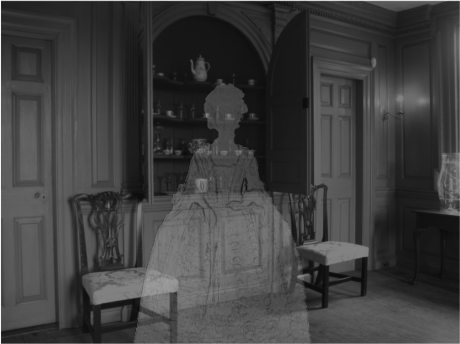
At that moment somebody in the street looked in at his window and immediately passed on again. Hermann paid no attention to this incident. A few moments afterwards he heard the door of his anteroom open. Hermann thought that it was his orderly, drunk as usual, returning from some nocturnal expedition, but presently he heard footsteps that were unknown to him: somebody was walking softly over the floor in slippers. The door opened, and a woman dressed in white entered the room. Hermann mistook her for his old nurse, and wondered what could bring her there at that hour of the night. But the white woman glided rapidly across the room and stood before him — and Hermann thought he recognized the Countess.
“I have come to you against my wish,” she said in a firm voice, “but I have been ordered to grant your request. Three, seven, ace, will win for you if played in succession, but only on these conditions: that you do not play more than one card in twenty-four- hours, and that you never play again during the rest of your life. I forgive you my death, on condition that you marry my companion, Lizaveta Ivanovna.”
With these words she turned round very quietly, walked with a shuffling gait towards the door, and disappeared. Hermann heard the street door open and shut, and again he saw someone look in at him through the window.
For a long time Hermann could not recover himself. He then rose up and entered the next room. His orderly was lying asleep upon the floor, and he had much difficulty in waking him. The orderly was drunk as usual, and no information could be obtained from him. The street door was locked. Hermann returned to his room, lit his candle, and wrote down all the details of his vision.
- “A man without morals and without religion. ”
[↩]
- “The Queen of Spades” was written a scant twenty-two years after Napoleon’s disastrous invasion of Russia, well within the living memory of Pushkin and a large part of his contemporaneous adult readership. Napoleon, therefore, was regarded as the very embodiment of rapine.
Mephistopheles is the demon who purchases the soul of Faust, who, like Hermann, is a German who succumbs to the temptation of the occult, thereby renouncing his own soul. Thus in a sense, Tomsky is comparing Hermann to the wrong character in the legend, but by invoking the name of the demon (always a dangerous act), he calls our attention to Hermann’s and Faust’s similarity, just as their names link Hermann and St. Germain. (See my comments on yesterday’s chapter.)
Part One of fellow poet Johann Wolfgang von Goethe’s masterpiece Faust was first published in 1808, and Part Two posthumously in 1832 (only two years before this story was written), both to sensational acclaim. Goethe’s influence on Pushkin is a matter of intense scholastic scrutiny.
[↩]
- “oubli ou regret?”: “forget or regret?”
This is a game played by the ladies to entice Tomsky to dance with one of them. Two of the ladies have drawn slips of paper upon which a single word is written, either “oubli” or “regret”. They are asking him to pick one of the words. After he pronounces his choice, the woman who drew the correct word will become his partner for the dance. This is why it states that “the lady chosen by Tomsky was the Princess . . . herself” in the next paragraph.
Pushkin is again playing a word game: although it is Tomsky who is asked the contextually innocent question, on another level it is Lizaveta who may regret and long to forget her association with Hermann.
[↩]
- Above, Pushkin gives her name as “Princess Pauline”, but masks her surname. Translators usually insert her first name here in lieu of the asterisks in the original, perhaps because they regard its omission as authorial carelessness. I prefer to think that it is only intended to look like an oversight, that by showing a slip in the narrator’s discretion, Pushkin is again suggesting that the story depicts real people and real events. This is exactly the same sort of “slip” as the one regarding the Countess’s surname. (Again, see my comments on yesterday’s installment.)
[↩]
- “in the the royal bird fashion”, i.e., with feathers artfully arranged in his coiffure.
[↩]
- Emanuel Swedenborg (1688-1772) was a Swedish scientist turned mystic who claimed to receive visitations directly from God and reputedly communicated with the dead. The quote itself was invented by Pushkin and attributed to Swedenborg, another instance of his use of pretended fact to bolster verisimilitude.
[↩]
I was surprised to find Pushkin mentioned near the end of a biography I am reading, “Panzer Leader” by Hans von Luck. The man led a charmed life. After fighting on every possible front during WWII he was captured by the Russians in the closing days of the war. This led to him spending years as a prisoner in Georgia. Although conditions were horrible for him, he was intrigued by the area because Pushkin, Lermontov and Tolstoy had lived there at various times.
I am no expert or scholar, but Russian literature has always fascinated me. It cannot be mistaken for anything other than what it is. I’m looking forward to Part VI and cannot even guess how it will end.
Have you read Stuart Kaminsky’s novels about a Moscow police detective? I have never been there but he seems to capture the mood of the country.
Thanks for the kind words yesterday about my story in AHMM.