
















The Docket

  • MONDAY:

    The Scribbler

    James Lincoln Warren

  • MONDAY:

    Spirit of the Law

    Janice Law

  • TUESDAY:

    High-Heeled Gumshoe

    Melodie Johnson Howe

  • WEDNESDAY:

    Tune It Or Die!

    Robert Lopresti

  • THURSDAY:

    Femme Fatale

    Deborah
    Elliott-Upton

  • FRIDAY:

    Bander- snatches

    Steven Steinbock

  • SATURDAY:

    Mississippi Mud

    John M. Floyd

  • SATURDAY:

    New York Minute

    Angela Zeman

  • SUNDAY:

    The A.D.D. Detective

    Leigh Lundin

  • AD HOC:

    Mystery Masterclass

    Distinguished Guest Contributors

  • AD HOC:

    Surprise Witness

    Guest Blogger

  • Aural Argument

    "The Sack 'Em Up Men"

    "Crow's Avenue"

    "The Stain"

    "Jumpin' Jack Flash"

    "The Art of the Short Story"

    "Bouchercon 2010 Short Story Panel"

Monday, August 29: The Scribbler

AN ANNOUNCEMENT

by James Lincoln Warren

AT SEA

    ‘Farewell and adieu’ was the burden prevailing
    Long since in the chant of a home-faring crew;
    And the heart in us echoes, with laughing or wailing,
         Farewell and adieu.
    Each year that we live shall we sing it anew,
    With a water untravelled before us for sailing
    And a water behind us that wrecks may bestrew.
    The stars of the past and the beacons are paling,
    The heavens and the waters are hoarier of hue:
    But the heart in us chants not an all unavailing
         Farewell and adieu.

—Algernon Charles Swinburne, A Century of Roundels (1883)

I have an announcement for our faithful readers which may cause some distress, but it is an announcement that all of us here at CB wanted to provide you well in advance to help soften the blow. The last day that Criminal Brief will be a “live” site is three weeks from today, on September 19, 2011. This isn’t a decision that was made lightly or quickly, and I will provide the reasons for it below, but before addressing them, let me make two very important points:

1. A successor site, tentatively titled “Sleuth Sayers,” comprising Rob Lopresti, Deborah Elliott-Upton, John M. Floyd, Janice Law, and Leigh Lundin is in the works and will go live in September, so the Gentle Reader is not being abandoned. I encourage all our faithful readers to migrate to the new site once it is up and running.

2. Although Criminal Brief will cease to be a live, interactive website, it will remain on line so that readers may explore our more than four years worth of archives at their leisure. There will simply be no new posts after September 19, and all the interactive features (like commenting) will be discontinued.

The Gentle Reader now asks, “Why? Why? Why?”

I conceived Criminal Brief as an advocacy site for crime short stories, and I think we fulfilled that function well and faithfully for a considerable time.

But the fact is that most of the articles are no longer related to trying to get people to read more short stories at all, but on other subjects entirely: travels, movies, true crime, novels, conferences, and so on. There is nothing wrong with that at all, and varying the subjects we touch upon has been a good way of drawing people into the primary focus of the blog, but it has gotten way beyond that. It has become the norm rather than the exception, and simply isn’t what CB was created for: after all, our subtitle is “The Mystery Short Story Web Log Project”. In other words, CB has evolved into a site where we the columnists now address our individual friends and fans instead of being a voice for getting people to read short crime fiction. After spending months mulling it over, I came to the conclusion that this is because we’ve done everything that we could, and that the transition to broadening the subject matter is the result of us having exhausted our efforts on keeping to the original premise. To tighten the focus now would be counterproductive: we’d simply be repeating ourselves ad infinitum instead of spreading our wings and seeking new horizons. If you think about it, this is entirely natural, that the contributors should move on. Why shouldn’t we? Life isn’t static. But it also means that CB has outlived the reason for which it was invented.

It’s a truism that after the opening sentence, the most important part of a good short story is a good closing. I promise you that the last three weeks of Criminal Brief will uphold the standards we began with. It had always been my policy as editor not to interfere with the subjects our regular contributors choose to offer, and I will not withdraw that policy now so near to its end, and so I suspect that our final week (Sept 12-19) will feature heartfelt farewells from each of the fine writers who have made CB such a joy to work on. But I would also remind you all that Rob, Deborah, Leigh, Janice, and John will continue to share their insights and thoughts after Criminal Brief lets go the anchor at last to cease from her long and eventful journey, so there is no cause for tearful good-byes.

The next two weeks will see a couple of Janice’s columns here on Monday’s slot, and I will return for the final column on Monday, September 19, with my parting shot.

Let me close for now by simply stating that Criminal Brief has been central to my life for almost every day of the last four and half years, and that I take great pride in what we’ve accomplished. But by far the most important part of it has been the privilege of reaching out to you, the Gentle Reader, and the formation of so many friendships that will never cease.

Posted in The Scribbler on August 29th, 2011
9 Comments »

Sunday, August 28: The A.D.D. Detective

The POINT of PUNCTUATION

by Leigh Lundin

Goodnight Irene

Florida braced for Hurricane Irene just as I was finishing roofing a house partially destroyed in a previous hurricane. After Category 4 and 5 storms, Floridians yawn at a mere Category 1. Indeed, surfers were out riding the waves, although one was killed when he was rammed head-first into the sand.

Category 1 doesn’t mean Irene shouldn’t command respect, especially in regions without hurricane-resistant building codes. One hundred MPH projectiles are deadly, especially if the projectile is human. Irene is taking its time, hammering some locations up to twelve hours as it moseys along.

Even minor storms can cause New York City problems. Winds that might be sub-hurricane at lower storeys could reach 150mph at the 150th floor. Architects design skyscrapers to flex in high winds. It can be intimidating to ride an elevator that slaps the sides of the lift shaft.

While writing this article, I thought Irene might bracket my article with clever transitions, punctuating the experience with excitement as it dashed up the coast. Thus far it’s done neither, for which we can be grateful.

Getting Good Marks

Punctuation as we know it didn’t appear until the 15th century. Since then, English has accumulated fourteen symbols. Languages like Chinese don’t require punctuation, although full-stops are now used in Japanese.

Not only can North American punctuation differ from British English (surprise!), but mavens within each don’t always agree about usage. When it comes to dialogue, the British often use single quotation marks whereas North Americans usually use double quotes. Twentieth century English writers may omit the period from abbreviated titles, e.g, Mr, Mrs, and Dr.

Another matter of dispute is whether to fully punctuate lists with a comma before the ‘and’, such as the above list: Mr, Mrs and Dr, versus Mr, Mrs, and Dr, the latter which Oxford University calls a ‘serial comma‘. Stylists in US legalese circles dictate the final comma should be omitted.

Some punctuation can have overlapping functions. At least two style guides suggest writers can precede lists with either colons or dashes.

The semicolon, half comma / half colon, has an undeserved reputation as a half-assed punctuation sibling, "indicating a pause, typically between two main clauses, that is more pronounced than that indicated by a comma." Parenthetically, I’ve notice the few times I’ve used a semicolon, editors usually change them to commas, as in “Everyone knew; no one did anything.”

Gotta Dash

You’re familiar with the big brother of the hyphen, the dash. Like spaces, they come in two flavors, the standard en-dash and the extra long em-dash. (The prefixes suggest the typographical width of the space and dash; i.e, the width of a lower case n and m.)

I’ve come across two recent articles that debated the dash, particularly the m-dash. Kamilla Denman discusses Emily Dickinson’s use of punctuation in an essay for Modern American Poetry. But writing for Slate, Noreen Malone gives us an object lesson about overuse of the m-dash.

In reading Noreen’s article, my ADD warred. I found the article interesting but the continual interruptions from spurious punctuation urged me to give up and move on to fascinating studies of Etruscan census lists. But, she gives us a compact literary history in this paragraph:

“ … "Dickinson’s excessive use of dashes has been interpreted variously as the result of great stress and intense emotion, as the indication of a mental breakdown, and as a mere idiosyncratic, female habit." Can there really be— at the risk of sounding like a troglodyte— something feminine about the use of a dash, some sort of lighthearted gossamer quality? Compare Dickinson’s stylistic flitting with the brutally short sentences of male writers—Hemingway, for instance— who, arguably, use their clipped style to evoke taciturn masculinity. Henry Fielding apparently rewrote his sister Sarah’s work heavily to edit out some of her idiosyncrasies— chief among them, a devotion to the dash. In Gore Vidal’s Burr, the title character complains— in a charming internal monologue— "Why am I using so many dashes? Like a schoolgirl. The dash is the sign of a poor style. Jefferson used to hurl them like javelins across the page." … ”

Dashed if I Know Quiz

As mentioned above, English uses 14 punctuation marks. All have been used or mentioned in this article, perhaps in devious ways. Can you name all fourteen?

Posted in The A.D.D. Detective on August 28th, 2011
15 Comments »

Saturday, August 27: Mississippi Mud

UNIDENTIFIED FLYING BOOGEYMAN

by John M. Floyd

This past Tuesday my wife and I returned from a week-long road trip to visit our oldest son and his family in Parkersburg, West Virginia. It’s a friendly city with an interesting history, set in a beautiful part of the country—and it’s located about fifty miles northeast of a place that I’d heard about long ago, a place known for what some would say are the wrong reasons.

I’m referring to Point Pleasant, West Virginia, a small town on the bank of the Ohio River. Point Pleasant gained national attention in the 1960s, when a number of its residents reported sightings of a winged creature (UFB?) later dubbed the Mothman. Described as a human-like, seven-foot-tall monster with glowing red eyes, it was said to live in an abandoned munitions factory nearby, and appeared only at night. As some of you might already know, it became the subject of a 1975 book, a 2002 feature film, and a 2011 documentary.

The book is The Mothman Prophecies by John Keel, which I’ve not read, and the documentary is Matthew J. Pellowski’s Eyes of the Mothman, which I thought was fascinating and well done. But the real reason I chose this for my column today is the movie, also called The Mothman Prophecies. It features Richard Gere and Laura Linney, and does an impressive job of fictionalizing the sightings and the legend, as well as the events that preceded one of the worst disasters in our nation’s history: the December 1967 collapse of the Silver Bridge between Point Pleasant and Kanauga, Ohio. Almost fifty people died in that tragedy, which happened during rush-hour traffic, and to this day some believe it was connected to the Mothman himself. (There are two reasons for this. One is that there were no more reports of sightings after that date; the other is that witnesses claim to have seen the strange creature perched on the bridge’s railing moments before its collapse into the Ohio River.)

Be advised, I wouldn’t say TMP is an outstanding film—it seems a little haphazard and disjointed at times—but overall it’s a good horror story, sort of a paranormal mystery, and contains the kind of eerie tension and anticipation that, besides being entertaining to viewers, can be instructive to writers of suspense fiction. These are characters that you come to care about, and there’s a satisfying surprise ending.

So that’s the lowdown. For more than four decades now, the Mothman sightings have remained unexplained—but they have also remained disproven. Besides, the people who say they saw the creature actually believe they saw it, and that alone makes the legend interesting. Watch the documentary and you’ll see what I mean.

Do I like this kind of story? You bet I do. Do I think the Mothman is real? Well, no. I don’t believe in the Mothman any more than I believe in the Loch Ness Monster or Bigfoot.

But I also made sure our recent travels through that area took place during daylight hours.

Just in case . . .

Posted in Mississippi Mud on August 27th, 2011
9 Comments »

Friday, August 26: Bandersnatches

TYPING THROUGH TEARS

by Steven Steinbock

It doesn’t happen often. I can probably count on one hand the number of times it’s happened to me. But this week I had to add another finger.

I’d been editing the novel. Draft Five if anyone is keeping track. A good friend of mine showed me how dear our friendship is by going through the manuscript (of draft #4) and giving it a deep read. His comments were right on target, and the frequent suggestions he provided nearly always made the text work better without compromising my own voice.

So I get to this one scene. It’s a touching scene. This particular scene involved notifying a relative of the deceased. Scenes like that are often done mechanically. But I was trying to get at the emotional toll that death takes. I was trying to be as honest as I could. I think I hit it right. Reading through my friends notes on the scene, I found it was getting hard to read.

I wiped my eyes and could see again.

But another paragraph down, things clouded up again.

This doesn’t happen often. It’s a good thing, too. It’s hard to write when all the letters look the same.

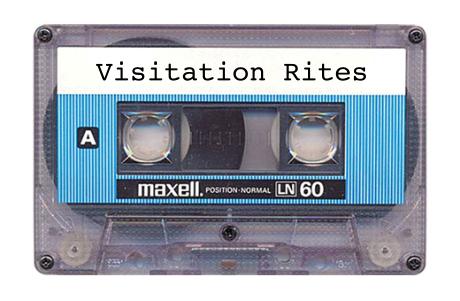
TAPING THROUGH YEARS

A different friend, this one going back to my high school days, surprised me last week by giving me a couple of audio CDs. The titles looked weirdly familiar. I flipped one over, and on the back side of the sleeve, I read:

Visitation Rites was originally a cassette mix compiled by Steve Steinbock in Stockton, CA, in about 1986, shortly after a summertime visit from his pals Grant and Cork.

He had uncovered the dusty cassettes somewhere in his archives, and transferred the recordings onto CD.

Quite a treat. I used to do a lot of these back when the cassette was king. I used to grab songs from vinyl LPs and occasionally odd bits of music or talk I found on the radio, and weave them together around some theme or another. At one point I had three different cassette machines plugged into one another, allowing me to do some simple overdubbing. (This was back when remixes were rare, and “rap” was something you did on a door with your knuckles. Although some reggae artists were experimenting with sound samples).

We put on the CD, and I was jettisoned back to my bachelor pad in the Eighties. The opening track was taken directly from an answering machine message I’d received from the friend who’d now brought me the CD. He was informing me, all those twenty-five years ago, that he was on Interstate 5, having driven from Seattle, and was currently in my vicinity of central California.

Answering machine messages were inserted throughout the compilation. Most were from people I was still in contact with. A couple times during the compilation, I’d done some extensive overdubbing of voices, resulting in a psychedelic collage of sound (a la “Revolution #9”). Listening now, I was impressed with what I’d been able to do without the benefit of computers and digital remixing equipment. I must have put in a lot of hours copying samples onto various cassettes, and then adding them to other recordings while fiddling with the balance controls. There were calls from other friends, from relatives, and from my mother. There were also clips from a radio interview for which I was the subject.

One of the telephone voices belonged to a girl whose name I’d long forgotten, but whose face and personality was still fresh. A character in my book, in fact, was modeled on my memory of this coffee shop barista. Hearing her voice now, wishing me a happy birthday in one message and reading a poem in another, I had to smile. But the smile was mixed with that someone-is-walking-on-your-grave feeling. On the messages, because the girl identified herself, I could now put a name on the memory.

I wonder what ever happened to her.

Posted in Bandersnatches on August 26th, 2011
5 Comments »

Thursday, August 25: Femme Fatale

PAGES OF TIME

by Deborah Elliott-Upton

    I think that I shall never see
    A poem lovely as a tree.

—“Trees” by Joyce Kilmer, 1886-1918

It seems everywhere I turn, people are having their trees loped off at ground level. Judging by their size, these are trees that have been thriving for a minimum of thirty years. It breaks my heart. Trees have given much to humans with their beauty, shade, and wind breaks. By their being harvested for heat and paper sources and for building materials, they have served a lovely purpose. Of all these, I am inclined to think none are more important reasons than another, but I can’t help being drawn to the paper element as one probably most important to civilization’s growth. What if we haven’t had paper? Those slabs of rock being chiseled into would be rather cumbersome to carry and I doubt not easy to carve into, thus less writers and needless to say, readers of the writings.

Have some trees died a needless death? Sure. Many books with little commercial success or worthiness have been published. Too many books have been involved in senseless book burning. And of course, there are all those stories of “olden days” where book pages were recycled for toilet paper.

In California, there is an attraction called Trees of Mystery. A 49-foot tall statue of “Paul Bunyon” is accompanied by a 35-foot tall “Babe, the Blue Ox.” The attraction contains many unique tree formations, giving the name to the tourist stop.

The mystery concerning me and trees are why some trees are left remaining to grace the ages while others are struck down in the prime of the life in a forest wildfire. Why are some woods more revered than others?

Ah, the mystery of trees seems to be the same mysteries plaguing mankind. Some are apt to live into very old age while others die early, many without warning.

What if we used every day to create something worthy of being written on paper for the ages? What if we all wrote like Dickens, Doyle, Hammett, Poe or King? Would we realize the worth of the best writers if all were exceptional at the craft? Or are we only better because there is diversity?

I heard once that Marlon Brandon’s acting career ceased to become what it could have after James Dean’s death. The two seemed to challenge the other to greatness. C.S. Lewis and J.R.R. Tolkien were critique partners who aided each other’s work. Truman Capote was influenced by his friend Harper Lee’s writing as was she by Capote’s.

I believe mystery writers get better because their readership keeps expecting more. Doyle brought Holmes back from the dead because the readers clamored for his return. Sequels are made mainly when they’ve made superior box-office returns on the investment. Series of books are only published when the customer keeps buying.

Trees are lovely and I suppose the time has come when not so many of them will be used for paper in this technological age of other avenues. Still, I will treasure my personal library of favorites and hope our stories find themselves worthy of someone’s space on their Kindle, Nook, or, iPhone, and occasionally on a page where the reader can literally smell the love I have put into the writing. It’s there, just between the lines and eased into the margins, a bit invisible like the trees where the pages began.

Posted in Femme Fatale on August 25th, 2011
5 Comments »

Wednesday, August 24: Tune It Or Die!

ON BECOMING ILLITERATE

by Rob Lopresti

I want to talk about something you probably know, but don’t think much about. The person you read about in these pieces is not the person writing them. Not exactly. Everybody who puts themselves out in front of the public creates a persona, if you will.

Putting it another way, anyone who watches the Colbert Report knows that the “Stephen Colbert” on the show is not the same guy as in real life. But the same thing is true of Jon Stewart on the Daily Show. Everybody who faces the camera (or more humbly, writes a blog in first person) picks and chooses what parts of themselves to share, and creates a figure that is not quite the real thing. As Dave Barry put it (I’m paraphrasing) “I hope the state of Florida wouldn’t give a driver’s license to the guy in my column.”

And so it is with yours truly. Some of the things I write here are more like the real me, some are less. But last fall when the me in this blog was blithely chatting about villains and sidekicks and the Gibson Girl, the real me had only one subject on his mind: eye surgery.

I had cataracts removed. The doctor said I was a bit ahead of schedule, but—here’s a cheery thought—everyone who lives long enough gets cataracts.

We scheduled the two exams for Thursday mornings, a week apart, so that I could take the two days off and have the weekend to recover. But I was worried. Would I be able to go back to work on Monday with one working eye? A friend who had gone the route before me assured me that it was easier than it seemed.

But I wasn’t much comforted. I had worn glasses since I was eight years old. Come Thursday my glasses would work on one eye, but not the other, and how would that work?

Came home after the surgery with a big patch over the effected eye. Took if off after a nap and made an absolutely amazing discovery. Turned out I had lost the color white several years before. What I had thought was white was a sickly yellowish sepia color. I could alternate between them by opening and closing eyes. Very weird.

The next amazing discovery happened when we went to bed that night. I could see the digital clock across the room! Without even squinting! Oddly enough, after a while my wife got tired of me announcing the time each minute. Takes all kinds.

The first week I muddled through by covering one eye and using my glasses to read with the other. But after the second operation that wasn’t possible, and I couldn’t get a prescription until my eyes settled down to something like a permanent disposition. So for the first time I went down to a drug store and tried reading glasses until I found something I could live with. (See me modeling them above.)

But along the way I had the unsufferable sensation of being quite literally illiterate. For the first time since first grade, I could not read. You see, when they remove the cataract the docs put in an artificial lens, and it doesn’t adjust. The worst, filthiest cataracted lense in the world still attempts to adjust between near and far. The artificial lens stays the way it is set. So before the operation I could, in a desperate situation, close one eye and hold a page practically against my face and read. Post-op this was no longer true

Obviously I like to spend a lot of my time reading books, but I hadn’t thought about how much of my time was spent reading other things. E-mail? Recipes? Heck, instructions on microwavable foods. Want to watch TV? Sure, but how do you know which program is on?

There are millions of people out there, who for one reason or another can’t read. It must be terrifying.

I spent a year once as a volunteer for our local literacy council. Didn’t feel like I helped the student much—he was an immigrant who had not had enough school in his home country to understand the basic structure of lessons and teaching that we all take for granted.

But if you can read this, thank a teacher. And your optician. And probably genetics.

Posted in Surprise Witness on August 24th, 2011
8 Comments »

Tuesday, August 23: High-Heeled Gumshoe

BLOG, BLOG, BLOG

by Melodie Johnson Howe


To see this video in full size, click here.

Blog, blog, blog, blog, blog, blog, blog, blog, blog, blog, blog, blog, blog, blog, blog.

Do you think I’m having a problem coming up with an idea for this column?

Blog, blog, blog, blog, blog, blog, blog, blog, blog, blog, blog, blog, blog, blog, blog.

Blog is not even a real word, for God’s sake. And we’re not really blogging. We’re writing columns. But if I repeated the word column it wouldn’t have the same empty-headed effect.

I could write about Ray Bradbury turning ninety-one. I think he has touched us all, not only with his imaginative writing but with his generous witty personality. He’s a writer who is very much like his work. Some writers are surprisingly unlike their novels and short stories, and not always in a good way. Don’t go there, Melodie. You can’t name names. Think of something else.

A wing walker fell to his death at a Michigan air show. I love the term wing walker. It captures the beauty and the derring-do of the act. But the fall was all reality. He tumbled through the sky his arms and legs he so depended on suddenly useless as if he were a scarecrow. But when he hit the ground he was very human. God, how did I get from Bradbury to wing walkers? Because Bradbury dared to perform on the edge of a wing. All good writers do, even if they know they can slip and fall.

Blog, blog, blog, blog, blog, blog, blog, blog, blog, blog, blog, blog, blog blog, blog.

I’m sick and tired of all politicians. ALL OF THEM! Who are these people and why are they chasing us? Pardon my slightly skewed homage to the Sundance Kid.

Blog, blog, blog, bog, blog, blog, blog, blog, blog, blog, blog, blog, blog, blog, blog, blog.

Oh, this is a first! Bones who had not played drums professionally for probably forty-five years is now part of the Mesa Jazz Ensemble. They played at the local art show. The group had only one rehearsal. I marvel at jazz musicians and how they know with little practice the songs, the riffs, and when to come in and when not to. “The first” I mentioned was not about Bones, but about me, of course. A woman who was there had heard my name mentioned. She turned around and asked if I was the mystery writer? Then she went onto explain that she had read my fist novel and had loved it. I don’t have a video of this moment. But I do have video of my husband playing. He’s the one in the hat behind the drums. I took this on my new iPad.

Blog, blog, blog, blog, blog, blog, blog, blog, blog, blog, blog, blog, blog, blog, blog,

I just realized why I’m having such a problem with this column. I’m on a deadline with my novel. I stopped in the middle of a sex scene to write this. I ask you, how much can one woman do?

Posted in High-Heeled Gumshoe on August 23rd, 2011
5 Comments »
« Previous Page — Next Page »

The Sidebar

  • Lex Artis

      Crippen & Landru
      Futures Mystery   Anthology   Magazine
      Homeville
      The Mystery   Place
      Short Mystery   Fiction Society
      The Strand   Magazine
  • Amicae Curiae

      J.F. Benedetto
      Jan Burke
      Bill Crider
      CrimeSpace
      Dave's Fiction   Warehouse
      Emerald City
      Martin Edwards
      The Gumshoe Site
      Michael Haskins
      _holm
      Killer Hobbies
      Miss Begotten
      Murderati
      Murderous Musings
      Mysterious   Issues
      MWA
      The Rap Sheet
      Sandra Seamans
      Sweet Home   Alameda
      Women of   Mystery
      Louis Willis
  • Filed Briefs

    • Bandersnatches (226)
    • De Novo Review (10)
    • Femme Fatale (224)
    • From the Gallery (3)
    • High-Heeled Gumshoe (151)
    • Miscellany (2)
    • Mississippi Mud (192)
    • Mystery Masterclass (91)
    • New York Minute (21)
    • Spirit of the Law (18)
    • Surprise Witness (46)
    • The A.D.D. Detective (228)
    • The Scribbler (204)
    • Tune It Or Die! (224)
  • Legal Archives

    • September 2011
    • August 2011
    • July 2011
    • June 2011
    • May 2011
    • April 2011
    • March 2011
    • February 2011
    • January 2011
    • December 2010
    • November 2010
    • October 2010
    • September 2010
    • August 2010
    • July 2010
    • June 2010
    • May 2010
    • April 2010
    • March 2010
    • February 2010
    • January 2010
    • December 2009
    • November 2009
    • October 2009
    • September 2009
    • August 2009
    • July 2009
    • June 2009
    • May 2009
    • April 2009
    • March 2009
    • February 2009
    • January 2009
    • December 2008
    • November 2008
    • October 2008
    • September 2008
    • August 2008
    • July 2008
    • June 2008
    • May 2008
    • April 2008
    • March 2008
    • February 2008
    • January 2008
    • December 2007
    • November 2007
    • October 2007
    • September 2007
    • August 2007
    • July 2007
    • June 2007
    • May 2007
Criminal Brief: The Mystery Short Story Web Log Project - Copyright 2011 by the respective authors. All rights reserved.
Opinions expressed are solely those of the author expressing them, and do not reflect the positions of CriminalBrief.com.